
Blog
Product Approval vs. Permit Approval: Which Fixes Your Install?
Confused about Florida product approval after installation? Learn how product approval differs from permit approval and the steps to resolve it.
Key Takeaways
-
A Florida product approval documents what a product is tested to do, while a local permit approval confirms that your specific installation meets code. You often need both to resolve an after-the-fact issue.
-
Locate the manufacturer, model or series, and approval number, then verify it on the state's Building Codes Information System at floridabuilding.org before contacting anyone.
-
Compare the approval against the actual installation: size, design pressure, substrate, fastening, and installation method. A valid approval number does not clear a mismatched installation.
-
Call your local building department first to learn what after-the-fact documentation it accepts, since requirements and fees vary by jurisdiction, including Miami-Dade's separate NOA framework.
-
Engineer-sealed documentation may help when records are missing, but acceptance is not automatic. The local authority having jurisdiction decides whether the evidence is acceptable.
-
Don't let an open permit, failed inspection, or violation sit. Gather photos, invoices, and labels early, since these issues rarely get easier with time.
So the windows are in, the roof is on, or the shutters are up, and then an inspector, a lender, or a code officer asks a question nobody planned for: where is the Florida product approval for this? If you are looking for Florida product approval after the fact help, take a breath. You are in good company, and this is more fixable than it feels right now.
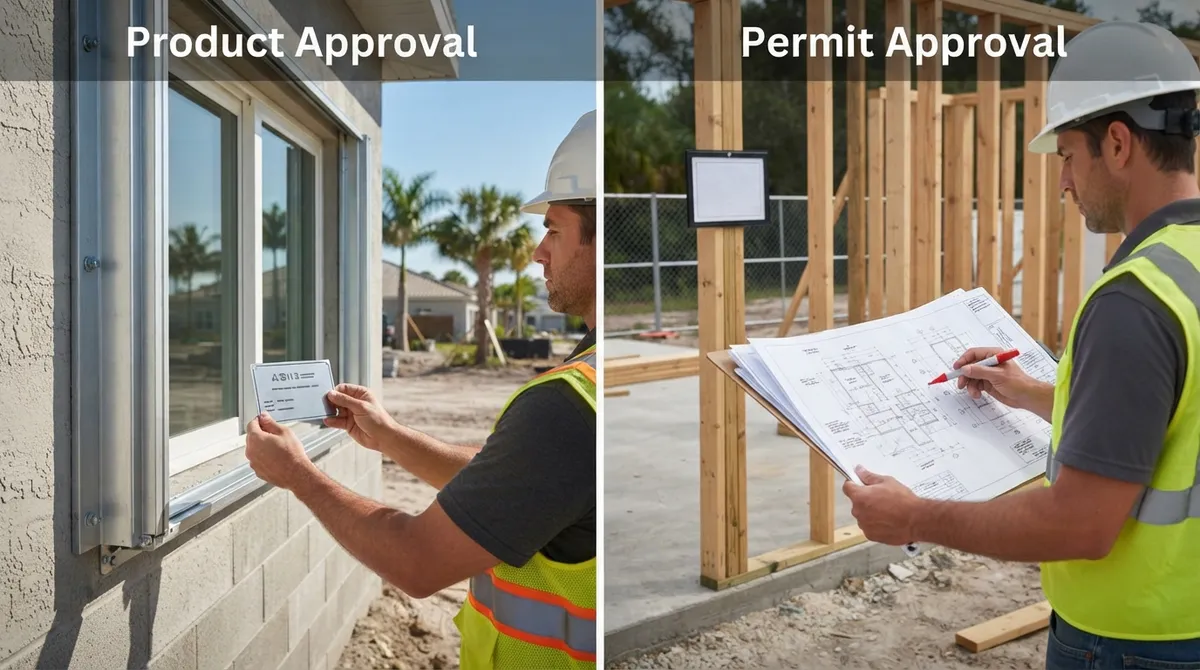
Here is the thing that trips up almost everyone: a Florida product approval and a permit approval are two different animals. One documents what a product is tested or evaluated to do. The other is your local building department deciding whether your specific installation meets code. Mixing them up is how people lose weeks chasing the wrong paperwork.
In this guide, we compare the two side by side, explain what each one can and cannot do for an installation that already happened, and walk through practical next steps. Whether you are a general contractor, a solar company, a realtor, or a homeowner, you will leave knowing which door to knock on first.
The Two Approvals Everyone Confuses
Think of it like a driver's license versus a traffic stop. A license shows you are qualified to drive. It does not mean you were driving legally at the moment an officer pulled you over. Product approval is the license. Permit approval and inspection are the traffic stop.
Florida's statewide product approval system, established under Florida Administrative Code Rule 61G20-3, applies to specified building-envelope and structural products. The state system has been in place since October 1, 2003. It covers eight categories:
- Panel walls
- Exterior doors
- Roofing products
- Skylights
- Windows
- Shutters
- Structural components
- Impact protective systems
A listing in that system tells you the product's documented performance and its stated limits of use. It does not tell you whether the product was installed correctly, in the right location, at the right size, with the right fasteners. That judgment belongs to the local building department.
Why this matters after the fact
When work is already in place, the question shifts from "is this product approved?" to "can we show this installation meets code?" Those are separate proofs, and you often need both.
Product Approval vs. Permit Approval: Side by Side
| Factor | Statewide Product Approval | Local Permit Approval |
|---|---|---|
| Who issues it | Florida Building Commission system (via floridabuilding.org) | Your city or county building department |
| What it documents | Product's tested or evaluated performance and limits | That the specific project and installation meet code |
| Scope | The product itself | The product plus size, location, substrate, fastening, and method |
| Can it be obtained after installation? | The approval exists on the manufacturer's side; you locate and verify it | Yes, through the jurisdiction's after-the-fact or corrective process, where available |
| Does it clear a violation alone? | No | Only when the department accepts the evidence and inspections pass |
Notice what the table reveals. You cannot really "apply" for statewide product approval on behalf of a product you did not manufacture. What you can do is find the existing approval, confirm it covers your use, and then take that evidence to the local department.
Step One: Identify What Is Actually Installed
Before anyone can help, someone has to answer a basic question: what product is this? The more you know, the faster the path.
- Find the manufacturer and model or series. Look for labels, stickers on window frames, product tags on shutters, or notes on the invoice.
- Locate the approval number. Manufacturers typically publish a Florida Product Approval number tied to each product line.
- Pull the installation instructions. The approval is paired with specific installation requirements.
- Gather the contract, invoice, and any photos. Photos taken during installation are gold if you have them.
- Record the installed conditions. Opening sizes, location on the structure, and the substrate all matter.
The state's Building Codes Information System at floridabuilding.org provides a searchable database of approved products, which is a useful first stop once you know the manufacturer and model.
What if the records are missing?
It happens constantly, especially with prior-owner work or contractors who vanished. If the manufacturer, model, or installation records are unknown, the path often runs through a design professional who can document the field conditions. We will get to that shortly.
Step Two: Check That the Approval Matches Your Installation
Here is where well-meaning folks get stuck. An approval number can be real and still not fit your situation. Every state product approval comes with conditions and limitations of use.
Compare the approval against what is actually on site:
- Size: Is the installed unit within the approved dimensions?
- Design pressure: Does the rated pressure suit the location and exposure?
- Substrate: Was it installed into the wall or deck type the approval contemplates?
- Fastening: Do the fasteners, spacing, and anchors match the published instructions?
- Installation method: Was the approved method followed?
If everything lines up, you have strong evidence for the building department. If something does not line up, you have found the real problem, and that is useful to know before you walk into a counter conversation.
What Can Be Done When There Is a Gap
Gaps usually fall into one of three buckets. Each has a different remedy.
| Situation | Typical Path | Who Decides |
|---|---|---|
| Product has approval and installation matches | Submit approval, installation evidence, and request after-the-fact permit and inspection | Local building department |
| Product has approval but installation deviates | Corrective work, or engineered documentation of the as-installed condition | Local building department, with design professional support |
| No statewide approval for the installed product | Project-specific technical documentation from a Florida-licensed design professional, where the code allows | Local authority having jurisdiction |
That last row deserves a friendly reality check. A Florida-licensed engineer or architect may be able to prepare project-specific documentation, but acceptance is not automatic. The local authority decides whether that evidence or an alternate method is acceptable, and engineering analysis cannot simply replace a test the code requires except where the code permits project-specific approval.
Understanding acceptable documentation
Rule 61G20-3.005 describes acceptable evaluation documentation, including certification, testing, or evaluation reports from qualifying entities. In some circumstances, an evaluation report prepared and sealed by a Florida-registered architect or licensed professional engineer is acceptable. Products within the rule's scope must also be made under a quality-assurance program audited by an approved entity.
Translation: paperwork quality matters. A sealed letter that is vague will not carry the day. A well-built package that ties the product, the conditions, and the installation together just might.
Why the Local Department Holds the Key
This is the part worth underlining. After-the-fact permits and corrections are handled by your local building department, not by the statewide database. Fees, inspections, documentation, and available remedies vary from one jurisdiction to the next.
That means what works in Tampa may not be identical to what works in Miami-Dade or Orange County. Miami-Dade, for example, has its own product-approval framework, which we break down in our guide to Miami-Dade NOA vs. Florida product approval.
Before assuming a product approval, an engineer's letter, or a retroactive application will solve your issue, contact the permitting authority. A quick call can save you from preparing the wrong package. If you are not sure which office reviews your address, our building department lookup is a handy starting point.
Timelines: Do Not Mix Up the Clocks
One more source of confusion is timing. The Florida Building Commission's 2026 materials describe state product-approval review periods of roughly two months for test-report and certain evaluation-report applications, and about 10 days for certification and some other evaluation-report applications.
Those are estimates for the state product-approval process. They are not timelines for a local after-the-fact permit, which can be shorter or longer depending on the jurisdiction, the complexity of the work, and how complete your package is. Also, the cited rule text was shown as current through March 25, 2025, so always confirm the current rule, code edition, and local requirements before relying on a specific procedure.
Who Needs This Help Most
Different readers arrive here from different directions. A few common scenarios:
- General contractors: A sub installed a product with no approval documentation, and now the final inspection is stalled. Our team supports general contractors with filing, tracking, and revisions.
- Solar companies: Mounting hardware or structural attachments need documentation tied to the roof covering and framing.
- Realtors and buyers: A closing is on the clock and a lender or inspector flagged replacement windows or a roof with no paperwork. See our realtor and closing support.
- Homeowners: You bought the house, found out about prior-owner work, and want to make it right.
In many of these cases, an impact window and door permit or a corrective roofing permit is the real destination, with product documentation as one piece of the packet.
A Practical Roadmap for After-the-Fact Product Issues
Here is a simple sequence that keeps you from spinning your wheels:
- Confirm the problem. Is there an open permit, a failed inspection, a violation, or a lender request? The remedy depends on which one.
- Contact the building department. Ask what they require for after-the-fact documentation of the product in question.
- Identify the product and its approval. Use labels, invoices, and the state database.
- Compare the approval to the installation. Size, pressure, substrate, fastening, and method.
- Close any gaps. Through corrective work or engineered documentation, as the department allows.
- File the after-the-fact permit package. Include plans, product data, and sealed letters where needed.
- Schedule and pass inspections. Then close out the permit.
If an open or expired permit is part of the picture, our after-the-fact and expired permits service covers that ground, and our engineer letters support exists for exactly the documentation gaps described above.
Where 1 Contractor Solutions Fits In
We are not a construction contractor. We are Florida's outsourced permitting department, and this kind of tangle is our daily work. We help sort out which jurisdiction controls your address, prepare the plans and documentation, coordinate with our in-house engineering, file the application, and work reviewer comments through to approval and closeout. Because drafting and sealed engineering are in-house, a reviewer's question gets answered by us, not by an outside consultant who needs a callback.
If you want a feel for how neighbors have fared, see what clients say on Google for 1 Contractor Solutions, and you can also follow us on LinkedIn or follow us on Facebook for practical Florida permitting updates.
Common Mistakes to Sidestep
- Assuming an approval number clears the issue. It documents the product, not the installation.
- Skipping the phone call. Jurisdictions differ, so ask first.
- Ordering an engineer's letter too early. Know what the department will accept before paying for documentation.
- Ignoring installation details. Fastening and substrate often decide the outcome.
- Letting the problem sit. Open permits and violations rarely get easier with time.
Wrapping It Up: Which One Fixes Your Install?
The honest answer is that you usually need both, in the right order. Product approval tells the story of the product. Permit approval, backed by inspection, tells the story of your installation. When you are looking for Florida product approval after the fact help, the winning move is to verify the product, check it against what was installed, and then take a clean, well-documented package to the local building department.
It may feel like a lot, but you do not have to carry it alone. If you would like a team that handles the research, the sealed documentation, the filing, and the follow-through, we would love to help. Reach out today and get a free quote, and let us help you turn that stalled install into a closed permit.
FAQs
Can I get Florida product approval after a window, door, roof, or shutter has already been installed?
You generally cannot apply for statewide approval on a product you did not manufacture, but you can locate the existing approval and confirm it covers your use. Then your local building department decides whether your installation can be accepted through its after-the-fact or corrective process. Requirements vary by jurisdiction, so a quick call first is a smart move.
How do I find a Florida Product Approval number for an installed product?
Start by finding the manufacturer, model or series, and any labels on the product itself. Then search the state's Building Codes Information System at floridabuilding.org to confirm the approval and its conditions. The installation instructions tied to that approval are just as important as the number.
Can a Florida engineer approve a product that has no statewide approval?
A Florida-licensed design professional may be able to prepare project-specific technical documentation, but it is not automatic acceptance. The local authority having jurisdiction decides whether that evidence or an alternate method is acceptable. Engineering analysis also cannot replace a test the code requires, except where the code allows project-specific approval.
Will a product approval number alone clear a failed inspection or violation?
Unfortunately, no. The approval documents the product, but inspectors look at size, design pressure, substrate, fastening, and installation method too. You will typically need an approved permit path, supporting documents, and passing inspections to close things out.
What if the manufacturer or installation records are unknown?
This is common with prior-owner work, and it is still workable. A design professional may be able to document the field conditions, and the local building department will tell you what evidence it will accept. Gathering photos, invoices, and any labels you can find will speed things up.
We do this work every day across all 67 Florida counties. Call (866) 314-6931 and we will tell you what your situation actually requires — including when you do not need us.
Related services
Permit Facilitation & Filing
You have a crew scheduled, a client asking for dates, and a permit sitting somewhere in a queue you cannot see. We file it, w…
See the servicePlan Review Coordination
A permit in plan review is not one queue. On a commercial project it can be six queues, each with its own reviewer, its own c…
See the serviceReady to get your permit moving?
One call tells you which jurisdiction controls your project, what it will take, and what it will cost. Most of the time we can scope it on the phone.